THC and the Developing Brain: What Parents and Young Adults Need to Know
The surprising facts that do not get mentioned
Cannabis use among teens and young adults has become increasingly common. With legalization, commercialization, and cultural normalization, many families now assume marijuana is relatively harmless—especially when compared to alcohol.
But neuroscience and clinical medicine tell a more complicated story.
As a board-certified family physician, I’ve seen firsthand how cannabis can affect young people’s mental health, emotional regulation, and long-term brain function. The concern is not occasional adult use—it’s THC exposure during brain development, when the brain is still actively wiring itself.
This article explains what the science actually shows, what risks are real, and why the developing brain deserves special protection.
What Does “The Developing Brain” Really Mean?
The human brain does not finish developing in adolescence.
Brain maturation continues into the mid-20s, with the frontal lobes—the last areas to fully mature—responsible for:
- Judgment and decision-making
- Impulse control
- Emotional regulation
- Motivation and goal-directed behavior
- Risk assessment
These regions are especially sensitive during adolescence and young adulthood.
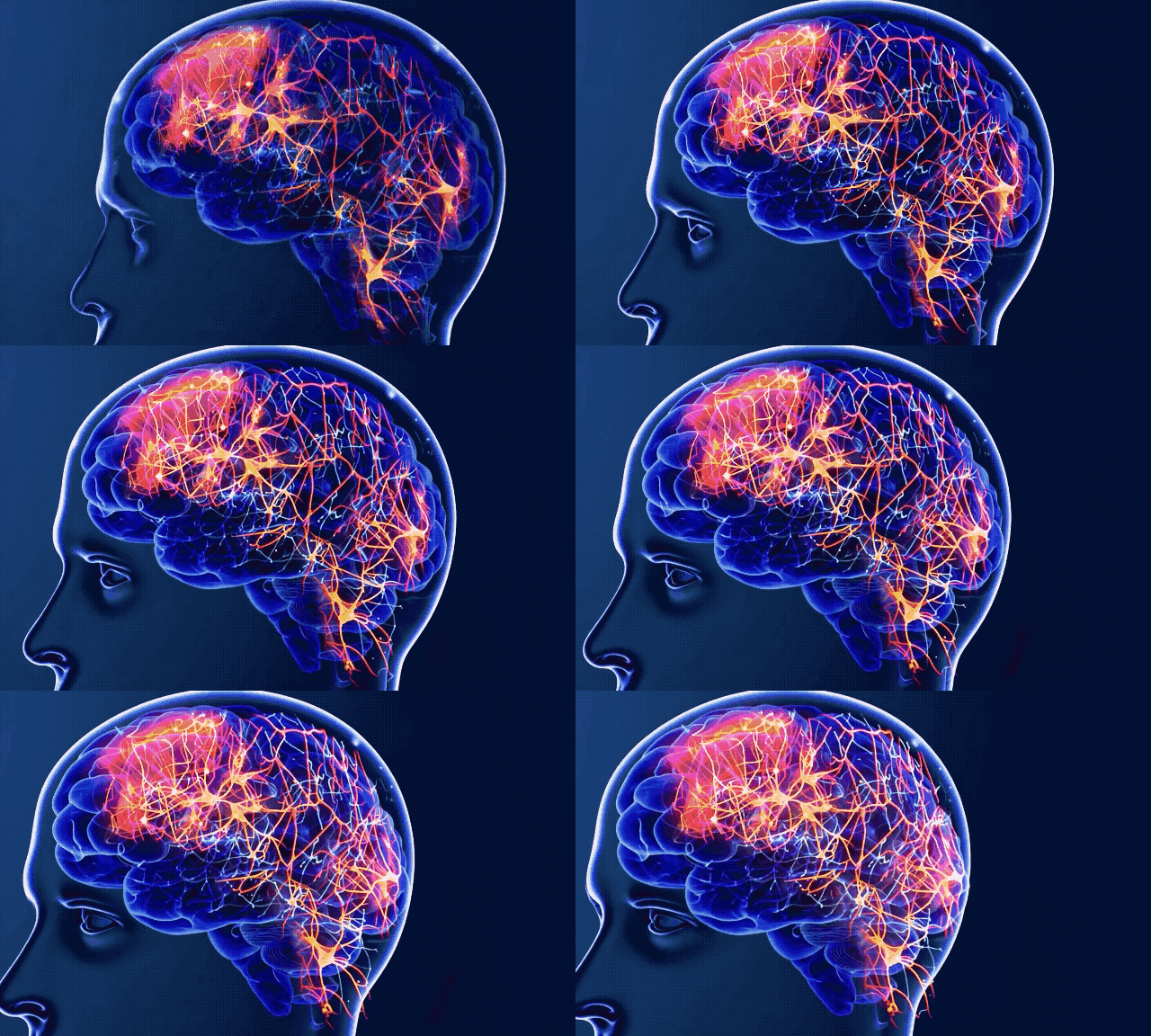
THC (tetrahydrocannabinol), the primary psychoactive compound in cannabis, directly interacts with the brain’s endocannabinoid system—a system that plays a critical role in guiding how neural circuits form, strengthen, and prune during development.
When THC repeatedly interferes with this process, it can alter how the brain wires itself—sometimes in ways that are not fully reversible.
Cannabis and Psychosis: A Real and Documented Risk
One of the most misunderstood—and often minimized—risks of cannabis use in young people is psychosis.
This is not an exaggeration or a fringe claim.
Large, well-designed epidemiologic studies consistently show that cannabis use is associated with an increased risk of psychotic disorders, particularly when:
- Use begins in adolescence
- Cannabis is used frequently or daily
- High-potency THC products are involved
- There is an underlying vulnerability (often genetic)
What Does Psychosis Actually Mean?
Psychosis refers to a loss of contact with reality. Symptoms can include:
- Hallucinations
- Paranoia
- Delusional thinking
- Disorganized thought and behavior
While some cannabis-associated psychotic episodes may be temporary, not all are.
In a subset of individuals, cannabis exposure appears to trigger the onset of chronic psychotic illness, such as schizophrenia—conditions that require lifelong treatment.
Importantly, cannabis does not need to be the sole cause. In many cases, it acts as the trigger that unmasks an underlying vulnerability.
Does Cannabis-Induced Psychosis Always Go Away?
No.
In some individuals, psychotic symptoms do not fully resolve after the drug wears off. Long-term follow-up studies show that a significant proportion of people who experience cannabis-associated psychosis later go on to develop persistent psychotic disorders.
Based on population-level data, some researchers estimate that for young people who use cannabis frequently—especially high-potency products—the lifetime risk of developing a chronic psychotic disorder may be as high as approximately 1 in 25.
That does not mean most users will develop psychosis.
But when the outcome can be permanent and life-altering, this level of risk is medically significant.
Today’s Cannabis Is Not the Cannabis of the Past
A common response from parents is:
“I used weed when I was younger and I turned out fine.”
That comparison no longer holds.
Modern cannabis products are dramatically more potent than those used decades ago. Many teens and young adults now consume:
- High-THC vape cartridges
- Concentrates and “dabs”
- High-dose edibles
Emergency departments across the U.S. increasingly report cases of:
- Cannabis-induced psychosis
- Severe paranoia
- Panic attacks
- Acute confusion and agitation
These effects are especially common with high-potency THC products, even in first-time or intermittent users.
Cannabis and Anxiety: Why the “Calming” Narrative Is Misleading
Many teens and young adults report using cannabis to help with anxiety. While THC may feel calming in the short term, this effect is often temporary—and misleading.
From a neurobiological standpoint:
- THC activates fear and stress circuits in the brain
- Repeated exposure can increase baseline anxiety
- The brain becomes more reactive over time, not less
Clinically, we often see a predictable cycle:
Anxiety → cannabis → short-term relief → rebound anxiety → increased use
Over time, the brain can lose its ability to regulate stress without the drug, worsening anxiety rather than treating it.
Cognitive Effects: Learning, Motivation, and School Performance
Cannabis affects precisely the cognitive functions that adolescents and young adults rely on most:
- Attention and focus
- Memory formation
- Learning efficiency
- Motivation and initiative
Early and frequent use is associated with:
- Poorer academic performance
- Difficulty concentrating
- Reduced motivation
- Slower cognitive processing
These are neurobiological effects, not moral failings or character issues.
What This Means for Parents and Families
This conversation is not about panic, punishment, or judgment.
From a medical standpoint:
- Avoiding THC is the safest choice for brain health under age 18—and realistically under age 25
- Regular use in teens and young adults should be treated as a health issue, not a discipline issue
Red Flags That Warrant Medical Attention
- Daily or near-daily cannabis use
- Use of high-potency THC products
- Worsening anxiety, paranoia, or mood instability
- Declining grades or motivation
- Sleep changes or personality shifts
When these are present, the next step should be a medical conversation, not a lecture.
The Bottom Line
Cannabis is not harmless for the developing brain.
The risks—particularly for psychosis, anxiety, and cognitive disruption—are real, well-documented, and in some cases permanent.
Protecting young brains is not about fear.
It’s about respecting how powerful—and how vulnerable—brain development truly is.
References:
- National Academies of Sciences, Engineering, and Medicine. The Health Effects of Cannabis and Cannabinoids (2017)
- Di Forti et al. The contribution of cannabis use to variation in the incidence of psychotic disorder across Europe. The Lancet Psychiatry (2019)
- Moore et al. Cannabis use and risk of psychotic or affective mental health outcomes. The Lancet (2007)
- Murray et al. Cannabis-associated psychosis: Neural substrate and clinical impact. Neuropharmacology (2017)
- Volkow et al. Adverse health effects of marijuana use. New England Journal of Medicine (2014)
- CDC & NIH adolescent brain development resources

Meet the Author
Dr. Georgine Nanos, MD, MPH
Founder of Kind Health Group