The Brain Fog That Won't Lift: When It's Not Just Stress or Age
Kind Minds TMS — physician-led brain health, Encinitas, CA. Medically reviewed by Dr. Georgine Nanos, MD, MPH.
You read the same email three times and still could not tell someone what it said. The word you wanted was right there, and then it was gone. You walked into the room and lost the reason. In a meeting, mid-sentence, the thread slipped and you had to cover for it. You are competent. You have always been the person who keeps track of everything. And lately you feel a half-step behind your own mind.
You have probably been told it is just stress. Or age. Or perimenopause. Or that everyone feels this way now. Read this slowly, because there is a more precise answer.
Brain fog is real. It is not a character flaw, a motivation problem, or something you should be able to push through. It is a measurable change in how your brain is performing — and when it does not lift on its own, it is worth understanding rather than explaining away.
What Brain Fog Actually Is
"Brain fog" is a plain word for something specific. When people describe it, they are usually describing three brain functions at once.
Attention — the ability to hold your focus on one thing without it scattering. Processing speed — how quickly your brain takes in information and responds, the reason a task that used to take a moment now takes visible effort. Executive function — the mental control room that plans, sequences, holds several things in mind at once, and lets you switch between them without dropping one.
These are cognitive functions, not personality traits. When they dip, you do not become less intelligent or less capable. You become slower and less reliable at the exact things that used to be automatic — finding the word, holding the thought, moving cleanly from one task to the next. That is why it feels so disorienting. The gap between who you know yourself to be and how your mind is behaving is the whole experience of brain fog.
What Drives It
Brain fog is a symptom, not a diagnosis. It sits downstream of how the brain is functioning, and several things upstream can pull those functions down — often more than one at the same time.
Mood. Depression and anxiety are not only emotional. They change concentration, memory, and processing speed directly. Many people arrive describing the cognitive fog long before they use the word "mood."
Sleep. Attention and executive function depend on real, restorative sleep. Fragmented or shortened sleep degrades them measurably, night after night.
Hormones. Perimenopause, menopause, postpartum, and thyroid shifts all affect cognition. Being told your fog is "just perimenopause" names a real cause — it does not mean nothing can be done about it.
Burnout and chronic stress. Sustained stress keeps the brain in a state that is poorly suited to focus and clear thinking. Over months, that becomes its own drag on cognition.
None of these make the fog imaginary. They make it explainable — and something a physician can evaluate rather than wave off.
The Pattern That Points Away From Decline
Here is the fear underneath most brain fog conversations — the one people rarely say out loud: that this is the beginning of decline. Something permanent. Something starting.
So here is the pattern worth knowing. Fog that fluctuates — worse under load, better on vacation, heavier some weeks than others — points away from degenerative disease. Degenerative processes are progressive; they don't take weekends off. Fog that tracks your stress is your brain reporting a problem, not becoming one.
If your fog rises and falls with your life, that is meaningful diagnostic information — and a reason to be evaluated, not to quietly catastrophize. In working adults, the far more common causes are the ones above: mood, sleep, hormones, and burnout. All measurable. Most of them treatable.
What TMS Is, and How It Works on These Networks
TMS — transcranial magnetic stimulation — is a non-invasive treatment that uses focused magnetic pulses to activate specific brain networks. There is no medication, no sedation, and no downtime. You sit in a chair, awake, and feel a light tapping sensation against your scalp. That is the whole experience.
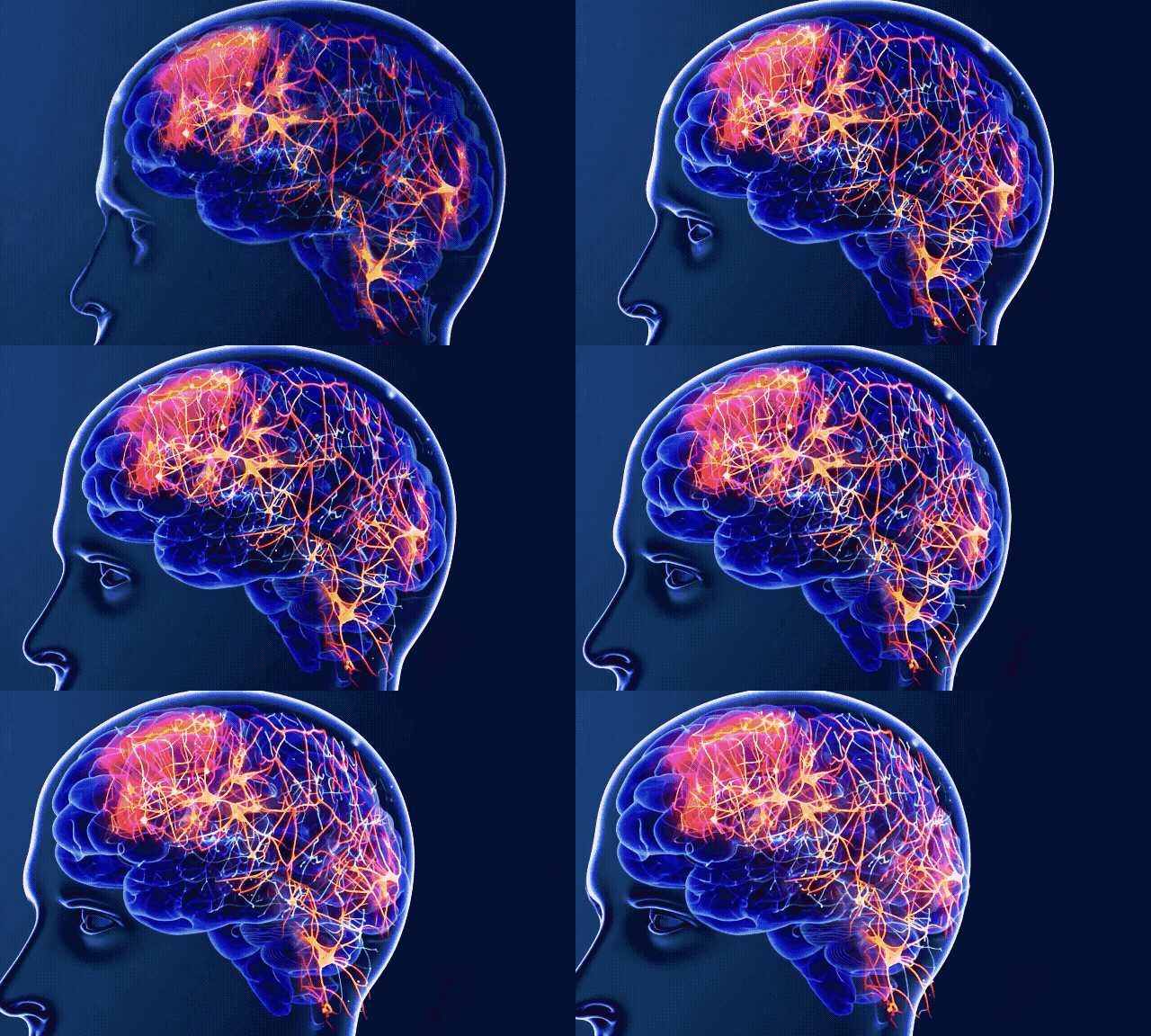
It helps to think of it less like a drug and more like targeted training for a specific part of the brain. The networks that govern attention, processing speed, and executive function are the same networks TMS is designed to reach. That is why it is relevant to a conversation about cognition, not only mood.
Here is the honest part, stated plainly. TMS is FDA-cleared for major depressive disorder, OCD, and smoking cessation. It is not FDA-cleared for brain fog or cognitive symptoms. When TMS is used for those, it is used off-label — a legitimate and common practice in medicine, but one that belongs entirely to physician judgment and individualized care, not to a protocol you can order off a menu. We will always tell you which uses are FDA-cleared and which are off-label. That distinction should never be blurred.
What is also true is what TMS does not do. It does not cause weight gain, sexual side effects, emotional numbing, sedation, or withdrawal. The most common side effects are a mild, temporary headache or scalp tenderness that fades within hours and diminishes after the first few sessions. The risk of a seizure is very low — under 0.1% — and every patient is carefully screened beforehand.
How Kind Minds Approaches It
Kind Minds is a physician-led brain health practice, not a high-volume TMS clinic. When brain fog is the reason someone comes in, the first job is not to treat — it is to understand what is actually happening.
That starts with measurement. We use NeuralChek, a cognitive assessment that measures attention, executive function, and processing speed objectively. Instead of asking you to describe a feeling, it gives us a baseline in numbers — which means we can see where the fog actually lives, and later see whether it is changing. Cognition you can measure is cognition you can track.
From there, care is directed by a physician and built around ExoMind™ neuromodulation, which allows higher-intensity, precisely targeted stimulation of the relevant networks. Where TMS is appropriate, it is applied under physician judgment and adjusted continuously as the brain responds. Patients do not choose a protocol. The brain does, and the physician designs care around it.
We also treat cognition as something to steward over time, not to discharge after a course of sessions. The brain does not heal on a fixed timeline, and mood, sleep, hormones, and stress keep shifting. So the value is in a year of care — measuring, adjusting, and protecting the gains — not a single treatment.
What You Can Do Right Now
If the fog has not lifted, and "just stress" has stopped being a satisfying answer, the next step is not to push harder. It is a proper evaluation of what your cognition is actually doing and why.
At Kind Minds, that starts with a Comprehensive Brain Health Consultation — a physician-led clinical evaluation of your history, your symptoms, and your candidacy for treatment, including objective cognitive measurement. This is a medical evaluation, not a sales call, and the fee is applied toward your care if you move forward.
You are not imagining it, and you are not simply getting older. You have a brain that is worth understanding precisely.
Frequently Asked Questions
Is brain fog a real medical thing, or is it just stress?
It is real. Brain fog describes measurable changes in attention, processing speed, and executive function. Stress can be one cause, but so can mood, sleep, hormones, and burnout — often together. It can be evaluated objectively rather than dismissed.
Is brain fog a sign of early dementia?
In working-age adults, rarely. Fog that fluctuates with stress and load is far more commonly driven by mood, sleep, hormones, or burnout. Persistent, steadily progressive cognitive change is a different pattern — and either way, objective assessment beats worry.
Can TMS help with brain fog and cognitive symptoms?
TMS targets the brain networks involved in attention, processing speed, and executive function. It is FDA-cleared for major depressive disorder, OCD, and smoking cessation — not for brain fog. Any use for cognitive symptoms is off-label and made under individualized physician judgment, which is why it begins with a medical evaluation rather than a protocol.
What is NeuralChek?
NeuralChek is a cognitive assessment used at Kind Minds to measure attention, executive function, and processing speed objectively. It gives us a baseline in numbers, so cognition can be tracked over time rather than guessed at from how a day happens to feel.
Is TMS safe, and what are the side effects?
TMS has one of the strongest safety profiles in modern psychiatry. The most common side effects are a mild, temporary headache or scalp tenderness that fades within hours. It does not cause weight gain, sexual side effects, emotional numbing, sedation, or withdrawal. The risk of seizure is under 0.1%, and every patient is screened for safety first.
Could my brain fog be from perimenopause or my thyroid?
It could. Hormonal shifts — perimenopause, menopause, postpartum, thyroid changes — genuinely affect cognition. Naming a cause does not mean nothing can be done. A physician-led evaluation can identify what is driving the fog and what, if anything, is worth treating.
Kind Minds TMS provides physician-led, longitudinal brain care in Encinitas, CA. To learn whether TMS is appropriate for you, book a Comprehensive Brain Health Consultation — a medical evaluation, not a sales call.

Meet the Author
Dr. Georgine Nanos, MD, MPH
Founder of Kind Health Group